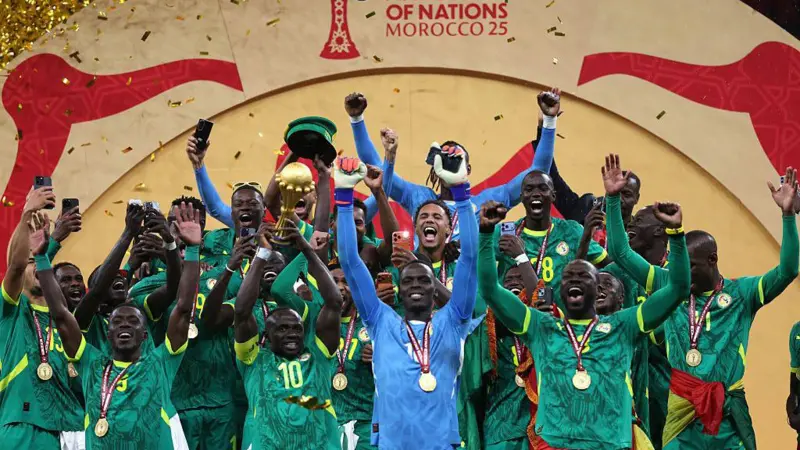
The curtain has fallen on the 2025 Africa Cup of Nations, but the real drama has only just begun.
Senegal’s players left the pitch in protest, not in defeat, only to watch the Confederation of African Football (CAF) strip them of their 1-0 victory in favour of hosts Morocco, rewriting history with a 3-0 paper win.
For the Senegal Football Federation, this is not a sporting loss—it is a perceived injustice that threatens the very credibility of African football. Stepping into the courtrooms of sport, Senegal has vowed to appeal the ruling to the Court of Arbitration for Sport (CAS), declaring that the truth, the law, and the honour of the continent are on their side.
How the Rules Changed the Result
CAF’s Appeals Board reached into the rulebook, citing Articles 82 and 84 of the AFCON regulations, which state that if a team refuses to continue playing or leaves the field without the referee’s permission, the match is to be forfeited and recorded as a 3-0 defeat.
The board reasoned that Senegal’s walk-off—born from fury over a controversial late penalty awarded to Morocco—constituted a forfeiture, even if the final whistle had not yet blown. In cold bureaucratic terms, the pitch protest became a regulatory knockout. The decision shifts the narrative from “who won the match?” to “who controls the rules?”—a question that now echoes far beyond the stadium.
Senegal’s Fight for Justice
Senegal’s leadership, however, refuses to accept victory by regulation over reality. The federation’s statement denounces the ruling as “unfair, unprecedented, and unacceptable,” accusing CAF of bringing African football into disrepute. Secretary General Abdoulaye Seydou Sow went further, branding the verdict a “travesty” with “no legal foundation,” accusing the panel of carrying out orders rather than delivering impartial justice.
Senegal’s case at CAS will likely focus on the principle that the referee’s on-field decision—and the final whistle—should be the ultimate authority, warning that retroactive changes open the door to future meddling in results.
To the Lions of Teranga, this fight is not just for their trophy, but for the integrity of every contest across the continent.
Morocco’s Quiet Victory
Across the border, the Royal Moroccan Football Federation has accepted the ruling with quiet satisfaction, framing it as a matter of upholding the competition’s regulations, not stealing glory. In their statement, they reaffirm a commitment to clear rules, fair competition, and the stability of African football.
The Atlas Lions, who had already endured the spectacle of a delayed final and a phantom penalty, now see their suffer in the glare of a different kind of scrutiny. This moment crystallizes the tension in African football: the line between enforcing the rules and abusing them could make or break the game’s future.
The Future of African Football
As the case moves to CAS, the stakes extend beyond Senegal and Morocco. The fear is that allowing results to be overturned long after the final whistle invites chaos into the sport—where every referee’s decision becomes vulnerable to retroactive revision. For the continent’s fans, this saga is a test of faith: faith in the referees, faith in the rules, and faith that the beautiful game will not be reduced to a courtroom spectacle. Whatever the verdict, one truth remains: the hearts of the players who ran, fought, and celebrated on that pitch will never be rewritten by any regulation. Their victory, their pain, and their passion are the real trophies of African football.